

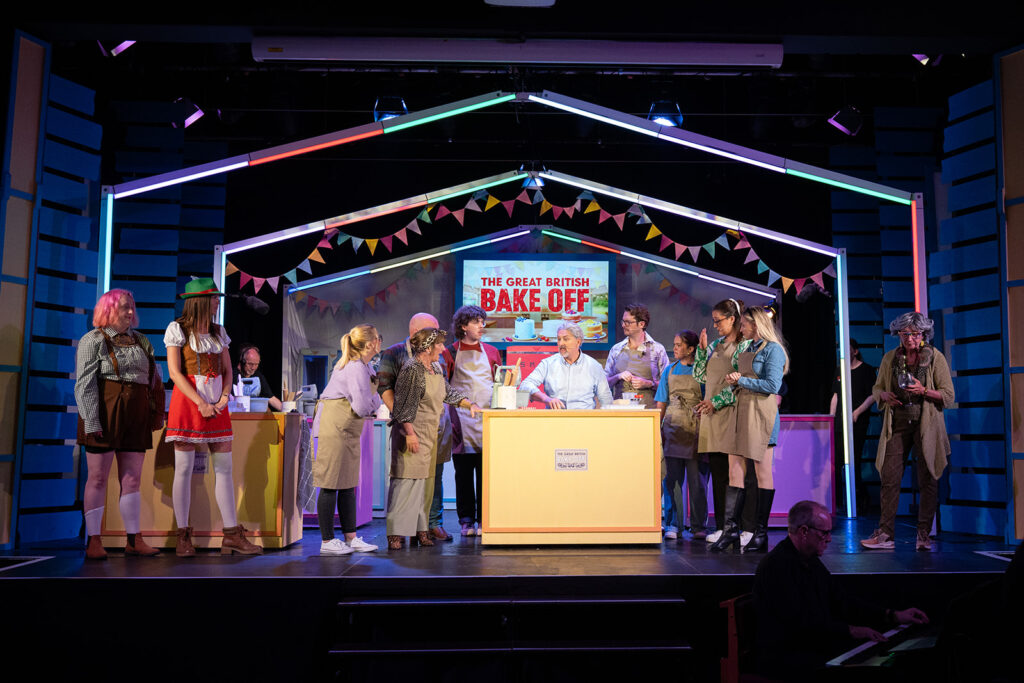
THE GREAT BRITISH BAKE OFF MUSICAL
Performed at Plymouth College, Plymouth
As seen by Nina Jarram, NODA SW District 3 Representative on Saturday 30th May 2026
Directed and Choreographed by Laura Pearce
Musical Direction from Phillip Simpson
From the very first moment, this production rose beautifully, like a perfectly proved loaf emerging from the oven. Opening with all the polish and confidence of a professional production of Sister Act, the company appeared in choir robes, delivering rich harmonies that were light, fluffy and expertly layered. This heavenly sound was delightfully contrasted with a comic sketch depicting the birth of baking, as two Neanderthals, Kim and Kat, brought prehistoric culinary chaos to life. Their confident a cappella singing and razor-sharp characterisation immediately established them as versatile performers capable of switching effortlessly between comedy and musical excellence.
The robes were soon whisked away as the ensemble transformed into the bustling crew of a television studio. Dressed in suitably suggestive crew T-shirts, they streamed through the auditorium and around the foot of the stage, creating the sense of a living, breathing production environment. While this was effective, there was perhaps an opportunity to fold the audience more fully into the action; cue cards prompting applause or audience participation could have strengthened the illusion that we were part of the studio audience ourselves.
Even when not at the centre of the action, the ensemble proved themselves indispensable ingredients in this theatrical recipe. Watching them work was like observing an experienced brigade in a professional kitchen: every facial expression, movement and reaction carefully measured and perfectly timed. Their commitment to storytelling never wavered, and they worked tirelessly to enrich every scene.
The Bakers themselves formed a wonderfully balanced mixture of personalities and vocal talents. Vocally secure, powerful and impressively blended, they demonstrated clear direction and thoughtful character development. Each performer brought their own flavour to the mix, resulting in an ensemble sound that was both cohesive and beautifully textured.
Particular praise must go to the actor playing Izzy, who succeeded brilliantly in making her character wonderfully unlikeable. Through convincing arrogance and mannerisms reminiscent of an Elle Woods-style influencer-in-waiting, she portrayed ambition with a glossy, over-iced confidence that made her every appearance compelling.
Gemma and Ben provided the emotional centre of the show, their chemistry proving as natural as butter and flour. Gemma delivered her songs with confidence and skill, her vocals rich and velvety with just the right amount of vibrato. Ben’s warmth and sincerity made him instantly likeable, and together they created some of the production’s most engaging moments. The standout among these was undoubtedly Ben’s duet with his young daughter Lily, revealing how she had secretly entered him into the competition. The number was baked to perfection—warm, heartfelt and utterly irresistible. Lily more than held her own opposite an experienced vocal powerhouse, contributing harmonies that were every bit as sweet as the show’s central theme.
Russell emerged as the kingpin of the Bakers. His stage presence radiated energy and confidence, filling every scene with vitality and a stunningly accurate accent and strong vocals. As a result, his departure from the competition genuinely deflated the atmosphere in the tent, a testament to the actor’s ability to make the audience invest wholeheartedly in his journey.
Hanan was portrayed with warmth, authenticity and considerable skill. The actor’s London accent felt entirely convincing, while her rapping brought an additional contemporary flavour to the production. Amidst a cast carrying varying degrees of emotional baggage, Hanan served as a refreshingly uncomplicated and optimistic presence—a lighter sponge amongst some richer, denser character studies.
Babs, meanwhile, delivered some of the evening’s most delicious comic moments. Draped in a riotous buffet of leopard print, she strutted, sashayed and hoofed her way through the show with enormous helpings of sass. Her showstopping eleven o’clock number, celebrating her unabashed attraction to judge Phil, was served piping hot and earned some of the biggest laughs of the night.
Alongside her, Pam demonstrated that age is indeed just a number. Armed with a major song-and-dance number and an impressively executed cartwheel, she showcased admirable skill and stamina. While there were moments when it felt she could have allowed herself to rise a little higher rather than matching the energy of the dancers around her, her character work was faultless. Every detail—from physicality and accent to costume choices and accessories—had clearly been considered and refined. Her comic timing was exquisite. Quite simply, Pam was the icing on an already impressive cake.
Phil, the other judge, arrived looking uncannily like the silver fox himself, Paul Hollywood. Combined with an excellent Scouse accent, the actor brought warmth, humour and charm to proceedings, providing welcome levity amidst the show’s more emotional moments. His vocals were secure throughout, and his duet with Pam, I’d Never Be Me Without You, evoked the spirit of classic comic musical pairings from shows such as Anything Goes and Gypsy.
Another crowd favourite was Dezza, whose repeated attempts to claw his way back into the competition proved consistently hilarious. Popping up at exactly the right moments, he demonstrated enormous stage presence and delivered a cameo performance packed with personality.
If comedy formed one layer of this theatrical confection, genuine emotional depth formed another. Francesca’s rendition of Grow, a song exploring infertility and disappointment, was handled with remarkable sensitivity. As the show’s only entirely straight role, it carried significant emotional weight, and the actor delivered it with grace and sincerity. Her beautiful vocals, combined with effective use of the ensemble to symbolise the ongoing struggle she faced, created one of the evening’s most moving sequences and left many audience members visibly emotional.
Throughout the production, Kim and Kat provided a reliable narrative thread as presenters, guiding the audience through the competition with ease and charm. Their costume changes became events in themselves, expertly facilitated by unseen backstage wardrobe wizards whose efforts deserve recognition.
Among the most memorable visual moments were the wonderfully absurd scone costumes worn by Pam and Phil during a number debating the correct pronunciation of “scone”. Combined with cleverly directed signs representing the eternal Cornish-versus-Devonshire jam-and-cream dispute, the sequence was delightfully silly and perfectly pitched.
The choreography throughout was inventive and consistently engaging. Baking movements became dance motifs, rolling pins became props of choreographic ingenuity, and one particularly charming sequence saw the bakers seated on stools, wielding wooden spoons as microphones in a scene that lovingly echoed a 1990s boy band performance.
Accompanying this gloriously chaotic mixture of mayhem and emotional recipe was a wonderfully accomplished group of musicians, headed up by Phillip Simpson, who guided the band with both skill and sensitivity. Like an expert baker overseeing a complex confection, he ensured every musical ingredient was folded together seamlessly, allowing the performance to rise into something richly textured, warmly satisfying, and perfectly balanced between exuberance and tenderness.
This is ultimately a show that depends heavily upon strong characterisation, and the principals delivered a feast of fully realised performances. The company should also be applauded for taking the bold step of launching in a brand-new venue. It was a brave gamble, and one hopes it proves financially rewarding. The intimacy of the space undoubtedly suited a character-driven piece such as this, allowing audiences to savour every emotional nuance. Yet there were times when the sheer professionalism and quality of the performances seemed deserving of a larger stage and a larger audience.
What remained abundantly clear throughout was the extraordinary talent gathered onstage. These are among the most versatile and accomplished performers in the local theatre community, and it was heartening to see so many fellow amateur dramatics enthusiasts supporting this exciting new venture.
Like the finest showstopper challenge, this production combined technical skill, creativity, humour and heart in generous measures. Warm, uplifting and expertly crafted, it proved to be a theatrical treat that left audiences thoroughly satisfied and eager for another slice.
DISCLAIMER Please be assured that the utterly delicious and wonderfully moist slice of Victoria Sponge gifted to me during the performance did in no way influence this review.
CINDERELLA By Mark Reid
Performed at The Oreston Centre, Plymouth
As seen by Nina Jarram, NODA SW District 3 Representative on Thursday 27 th
November 2025
Written, Directed and Choreographed by Mark Reid
Musical Direction from Phillip Simpson
The production opened by sweeping the fourth wall aside in true pantomime tradition, with the Cinderettes bursting onto the stage and immediately establishing
themselves as Cinderella’s confidantes and our narrative guides. Their arrival also set the cheeky, irreverent tone for the evening, embracing innuendo with an unabashed confidence that made the audience instantly aware of the genre they were stepping into. Vocally, the Cinderettes were outstanding. Their harmonies were
rich and assured, their energy unwavering, and their collective charisma lit up the stage. They became the heartbeat of the show, maintaining drive and momentum even when the pacing of the script dipped. The actor playing Poppy, in particular,
proved a formidable triple threat, and the natural ease of the ensemble’s chemistry ensured their scenes were always engaging and fluid.
Despite the limitations of a compact performance space, the renowned vocal strength of the Sounds company did not disappoint. The Musical Director’s influence was clear: harmonies were tight, confidently executed, and beautifully balanced with
choreography that was thoughtfully tailored to a range of abilities. This inclusivity meant performers could commit to character without sacrificing facial expression or vocal clarity. The ensemble, often the unsung backbone of any pantomime, were
given room to develop individual characters, resulting in a tapestry of distinctive personalities that brought vitality and texture to every group scene.
The principal cast delivered familiar archetypes from the pantomime canon.
Cinderella was portrayed as the classic ingénue, youthful, fair, and radiating sincerity—while Buttons’ characterisation leaned less toward the traditional buffoon and more toward a gently resigned, friend-zoned companion. Though his comic delivery occasionally felt tentative, his vocal moments were warm and appealing, and his physical comedy was grounded in well-timed farce.
Projection, however, proved a challenge for some. Several performers lost vocal dynamics at the ends of lines, with sound fading before reaching the audience. A notable exception was the actor playing Dandini, who shone with a clear grasp of
pantomime rhythm and style. With a performance reminiscent of Ben Miller’s dry wit, he balanced thigh-slapping bravado with razor-sharp sarcasm and impeccable timing. His control over audience focus and the narrative arc was exceptionally strong.
The Ugly Sisters were a riot of colour, chaos, and commitment. Though slightly precarious in their towering heels, they embraced the absurdity of their roles wholeheartedly. A note of caution, however: several lines were lost when upstage turns and large wigs obscured both sound and facial expression. Ensuring that
dialogue is delivered squarely to the audience will preserve clarity without diminishing characterisation.
The Wicked Stepmother delivered a visually striking performance, her wig alone deserved its own spotlight, though her interpretation leaned more glamorous than menacing. A sharper pace and more overt villainy would have heightened the contrast with the lighter characters. The Queen, also played with a relaxed air, used
this softness more effectively, especially in scenes with Dandini where her dry disdain offered delightful comedic contrast.
The Fairy Godmother provided a refreshing shift from the expected Glinda-esque archetype. Her eccentric, goofy interpretation added warmth and unpredictability, contributing to the show’s broader sense of playfulness. The Prince, meanwhile, demonstrated strong musical-theatre credentials but seemed slightly outside his
comfort zone with the rapid-fire spontaneity and improvisational edge essential to pantomime. Nevertheless, his engagement with the audience, particularly through distributing invitations to the Ball, created charming interactive moments. The spontaneous inclusion of audience members seated on “special invitations” added a
joyful layer of surprise, embraced gamely by those selected.
Several full-company numbers enhanced the excitement, most notably the vibrant rendition of Rainbow Connection, which showcased the Musical Director’s skill and the cast’s collaborative strength. A standout moment came during the Ball with an
unexpected Meat Loaf number accompanied by a live saxophonist. This departure from the traditional waltz invigorated the scene and allowed Cinders to prove her versatility beyond the classic Rodgers and Hammerstein ingénue mould. The sequence was visually and musically exhilarating, with the ensemble’s individual
character work bringing the stage to life.
The production, though rooted in pantomime tradition, often resembled a polished musical, owing to its strong script and assured performances. With a company evidently capable of more, the suggestion for future productions would be to take
greater risks in direction, embracing the full, chaotic potential of pantomime’s improvisatory spirit.
Costumes were a visual delight, bright, sparkling, and playfully eccentric, contrasting beautifully with the more traditional attire worn by Dandini, the Prince, Cinderella, and the Queen. The set design, centred around a storybook whose pages turned to
reveal new scenes, was both elegant and practical, reinforcing the fairy-tale motif without overwhelming the limited space. The pumpkin-to-carriage transformation was nothing short of enchanting: a masterful piece of creativity demonstrating that
innovation, not budget, is the true engine of theatrical magic.
In summary, this was a vibrant, wholeheartedly executed community
production—collaborative, inclusive, and filled with opportunities for performers to shine. It reinforced the truth that the spirit of theatre lies not in its venue but in the people who bring it to life.
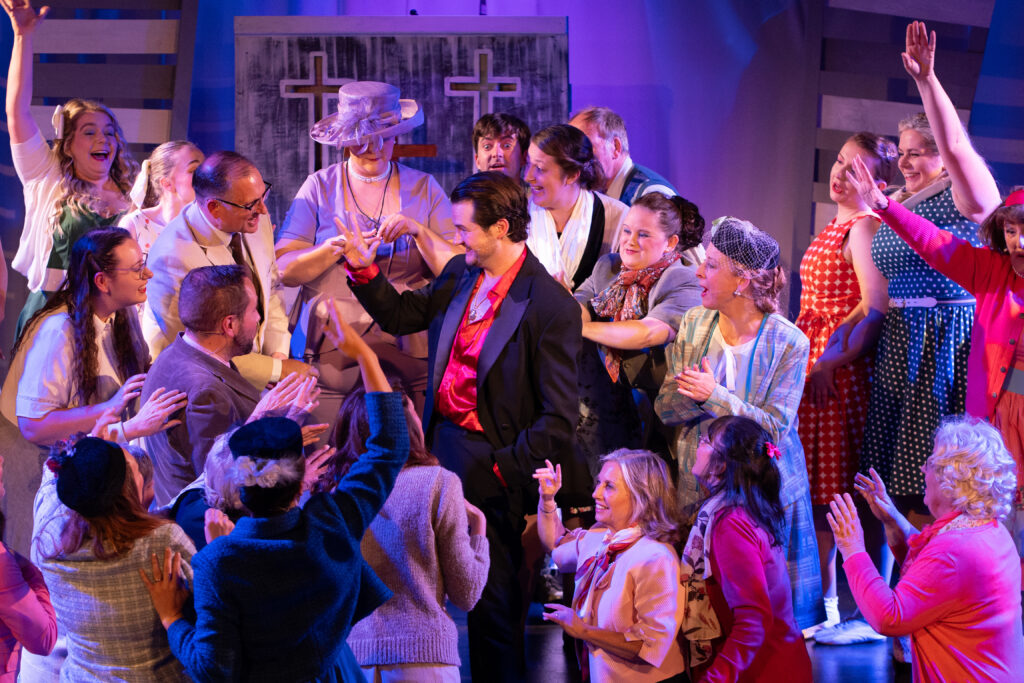
The Witches of Eastwick
Performed at The Devonport Playhouse
As seen by Nina Jarram, NODA SW District 3 Representative on Thursday 5th June 2025
Directed and choreographed by Laura Pearce
Musical Direction by Phillip Simpson
We were introduced to Eastwick, the setting of this musical based upon the 1987 film of the same name, through a simple set depicting suburbia, yet lit in red thus suggesting that all may not be well here. Wonky fence posts lent in presenting us with a caricature instead of the usual naturalistic set, as a little girl with pure vocals and excellent storytelling opened the show with a huge amount of confidence bereft of her age. She beautifully sung the almost macabre melody indicating that Eastwick knows.
An enthusiastic ensemble resplendent in costume portraying all American goodness and innocence flooded the stage giving each cast member the opportunity to develop their own characterisation within this story and many pulled focus with their animated facial expressions and confident movements. There were some excellent cameos from three actors who led the company with strong vocals and choreography.
This colourful ensemble continued to competently support both the principals and the storyline with their charismatic animated interpretation of characters which they brought with consistent energy. Movements had been well drilled and I thought that the choreography portraying the power that was held over them as townsfolk by the leading man, was well constructed and translated creatively within the correct context. In general, the choreography was suitably differentiated to be accessed easily and competently by all. A particular mention to the four dancers who were able to respond more expertly to some more challenging movements and who pulled focus with their excellent stage presence, confidence and artistic fluidity to successfully transition from vanilla to spice!
The actors depicting the three ‘witches’ were strong performers and vocalists and were able to keep the audience engaged in the storyline whilst effectively delivering three totally juxtaposed characters in line with the outline of the story. The actor playing Suki had a great stutter demonstrating her insecurities which gradually disappeared as she developed in confidence through her blossoming relationship with Daryl. Alongside this well executed characterisation, she had strong vocals and was able to competently hold the beautiful harmonies with her other contemporaries.
The actor playing Jane also presented initially as a shy woman still emotionally affected by her divorce showing a lack of confidence and self-worth. Her experience as a performer shone when tackled with a challenging song whilst seemingly playing the cello. Both her bow strikes and her top note strikes were on point and we enjoyed the development of her character through higher heels, shorter skirts and a command of her newfound sexuality.
The actor playing Alex was meant to be the strongest personality of the three women and where the other three actors had somewhere to go with their growing sense of importance and assertion, I feel that Alex as a character could have presented as feistier and fiercer, as her new persona unfolded alongside the others. The actor was very grounded and confident and displayed some beautiful vocals, the tone of which worked particularly well in the harmonies in the trios.
It is easy in conversational dialogue to forget that each line needs to be punchy so that it is heard and there were places when the level of projection at these times meant that it was hard to hear what they were saying due to lack of volume and thoughtful pace.
Our love interest for these delightful yet frustrated women was Daryl Van Horne (DVH), a man who mysteriously enters the lives of these celibates pulling the metaphoric rug from under their feet and keeping them on their toes. This is a difficult role to play as the character needs to be played by a strong singer, actor and dancer with heaps of charisma and energy. Luckily for this company there was an actor who magically appeared to lift this role from the page and bring it to life. There were undertones of Jack Nicholson, who played DVH is the original film served up with a bit of Elvis and Danny Zuko to create the perfect potion. The actor’s delivery of lines was punchy and velvety and the females in the audiences fell in love with him as the male audience members hated him whilst secretly wanting to be him. Throw in a bit of dad dancing, an abundance of hair gel, a large dose of nonchalance, contempt, cockiness and waver less energy and we have a leading man who commanded the stage with every well thought out gesture and intense physicality.
The actor playing Michael was suitably geeky as the opposite of an all-American football player taking inspiration of Little Shop of Horrors Seymour and Rocky Horror Show’s Brad. He had great chemistry on stage with the actor playing Jennifer and their vocal complemented each other perfectly. They had fun with the total transformation of their characters as they too succumbed under the influence of Eastwick’s newest resident.
The actor playing Felicia was suitably overpowering and she executed the clever illusions of witchcraft with slight of hand perfection and timing as DVH and his witches cast spells over the town’s domineering and unlikeable matriarch. All her retching did not compromise her vocals and we enjoyed this almost pantomime-esque villain. In contrast, her husband was a mixture of a meek man, an alcoholic and a philanderer who was in an unbelievable relationship with Suki which was not made obvious enough due to a lack of physical interaction and chemistry. Due to the implausible plot, there was the opportunity for these characters to be portrayed with more deliberate exaggeration especially in the shadow of DVH, a huge caricature of a role.
The unusual sidekick of our ‘Devil’ was Fidel, a character who kept popping up in various guises wearing a collection of costumes chosen to keep us guessing as to his background, his nationality and his overall purpose. What was obvious however, was that the actor playing this vocal less role was a very experienced comic with hilarious facial expressions, excellent stage presence and the ability to make us laugh without in fact saying or doing anything of note. Superbly done!
The witches had been well drilled by the Musical Director to have learnt and produced such strong and beautifully owned harmonies. He also expertly commanded his show band in the orchestra pit as they produced the perfect sound to this montage of magical madness.
Costume was imagined extremely well with DVH mirroring the personalities of his mistresses in his own attire. The ensemble was well informed in their twin set and pearls portraying a sensible, subdued and sexless society. Outfits chosen were cleverly attuned to the context and the mood and there was a subtle nod to Pride month in the Vicar’s rainbow stole.
Set was simple and at times changes were executed quite noisily which I expect would have ironed itself out as the week went on. Radio mics did not always pick up all of the dialogue though this doesn’t necessarily denounce the equipment or the operation. When a character is presenting as meek and shy, this must be conveyed through body language and facial expression so as not to compromise vocal dynamics. There were extremely distracting and blinding side lights either side of the stage which were rotating at regular intervals although I was unsure as to what relevance they had and what artistic intent they brought to the production. Some of the more effective technical additions were projections during the songs; music notes for the cello scene, letters for the ’Words’ song and a clever reveal of DVH himself. There is also the danger of overdoing the haze effect which can hinder focus and deter from the action. The effect of the bubble machine during the number, ‘Dirty Laundry’ however was inspired and very effective, a lovely touch to the production.
This was a well-directed piece of theatre with an emphasis on physical comedy ably executed by an experienced cast. It had obviously been well rehearsed resulting in a confident and cleverly crafted portrayal of this underperformed musical. All the fictional stock characters were represented, from the heroines to the wicked parents, to the villain, magic was involved and a fairytale ending ensued. This montage of colourful dramatis personae leads them nicely into their next venture exploring the pantomime genre.

9 TO 5 THE MUSICAL – Feb 2024 – The Devonport Playhouse
NODA AWARD RECIPIENT: Outstanding Achievement Award
NODA AWARD NOMINATION: Stage Decor
Directed and choreographed by Laura Pearce
Musical Direction by Kristy Marcer-Griffiths
Thank you very much for inviting me to your production of ‘9 to 5 The Musical’. The welcome I receive every time I attend one of your productions is just exceptional and your front of house team as always are a credit to the company.
May I first start by saying what an enjoyable evening my wife and I had. We thoroughly enjoyed our visit and I sincerely hope the rest of your run went well. You certainly deserved to reap the rewards of what was clearly a very focussed rehearsal period. This was the first time I had watched 9 to 5 and it certainly did not disappoint.
9 to 5 is a relatively new musical based on the film of the same name with music and lyrics by Dolly Parton. The story follows the journey of an unlikely trio: Violet, a strong office supervisor with high ambitions for progression in a male dominated world; Judy, a recent divorce struggling to make her own way in a world where she has so little experience; and Doralee, a misunderstood woman who’s co-workers despise. Her over rumours spread by her boss which are entirely false. The three women end up bonding over their shared feelings towards Hart and end up changing the business world for the better showing the CEO of Consolidated Industries just how strong a woman in charge of the office can be.
The set
The set was provided by Andy Martin Productions and upon entering the auditorium the audience were greeted by a sleek, minimal set that had a real air of professionalism that would be at home in any professional setting. Built into the back wall of the set were two television screens that displayed the show logo and would go on to be used throughout the production including the interludes from Dolly Parton herself. LED lighting strips donned the wings from floor to ceiling and further added to the opening set.
Scene changes throughout the production were incredibly slick with many of them being handled expertly by the cast themselves. The quick change of scene from bedroom to office was well choreographed and with the cast completing this change it added a sense of the hustle and bustle of a busy office environment. The set generally remained fairly simplistic throughout with a minimal amount of major set pieces needing to be moved into place. This enabled the action on stage to keep pushing forward at a good pace throughout.
Lighting
Lighting was very effective throughout the production and ensured a good wash of colour flooded the stage. I very much enjoyed the translucent panelling on the back wall which was then lit with various LED colours throughout which helped set a new time or location. This was a nice touch and further enhanced the set. The lighting did exactly as it should, added to the narrative but wasn’t so in your face with special effects that it distracted you from what was happening on stage.
Sound
I am always pleased to see a company that is still using a live band. I know with raising costs that more and more companies are now having to move toward the use of tracks but a live band really does add a huge amount to the show. The band were ably led by Musical Director Kristy and the band were sympathetic to the environment they were working in striking a good balance between giving it good energy but not overpowering the performers onstage. Most of the principals and named ensemble had head worn radio mics. These ensured that all dialogue was heard right at the back and also that the vocals during the songs were well projected over the band.
The opening number ‘9 to 5’ was excellent and really set the tone for the whole production. The cast were confident and harmonies were well delivered. It was fantastic to see every single person looking straight out into the audience and engaging every single person in the audience.
Costume and Makeup
Costumes throughout the show were excellent and were absolutely spot on suiting every single character perfectly. I was very surprised to hear that the cast had self-sourced their costumes. The costumes complemented each other and were absolutely in keeping with the era and location for this show. The number of quick changes throughout was vast and each and every change was handled with such ease.
Additional comments
There was certainly no shortage of talent on display in this production and each and every member of the cast played an important part in the telling of this story. There are some individuals I would like to highlight however.
Doralee. Wow! Outstanding. What an absolute super talent. I along with many members of the audience was just blown away by the vocal talent on display by this performer. ‘Backwards Barbie’ was excellent. Doralee was not just a good singer but also a fabulously talented actress with a strong convincing Southern American accent to match.
Violet and Judy were equally talent and the three women combine were a superpower to be reckoned with. The relationships and bond that grew over the production was believable and really drew the audience in. ‘I just might’ sounded absolutely incredible. ‘Get out and stay out’ was full of passion and was really did portray the journey that Judy had been on throughout the show.
Roz is another actress well deserving of recognition. Heart to Hart was delivered superbly and provided such a huge amount of comedy. As an actress Roz did a fantastic job of playing the devoted office secretary to a sleazeball of a boss, Franklin Hart.
Speaking of which, Franklin Hart was yet another strong performer who did a good job to portray a narcissistic, sexist, misogynistic male in a world that was dominated by men. He had a good command of the space and was convincing in his conviction. As a vocalist he was very strong and projected superbly throughout ‘here for you’.
Congratulations on a fantastic opening night
Kind regards
Ryan Procter
District 3 Representative
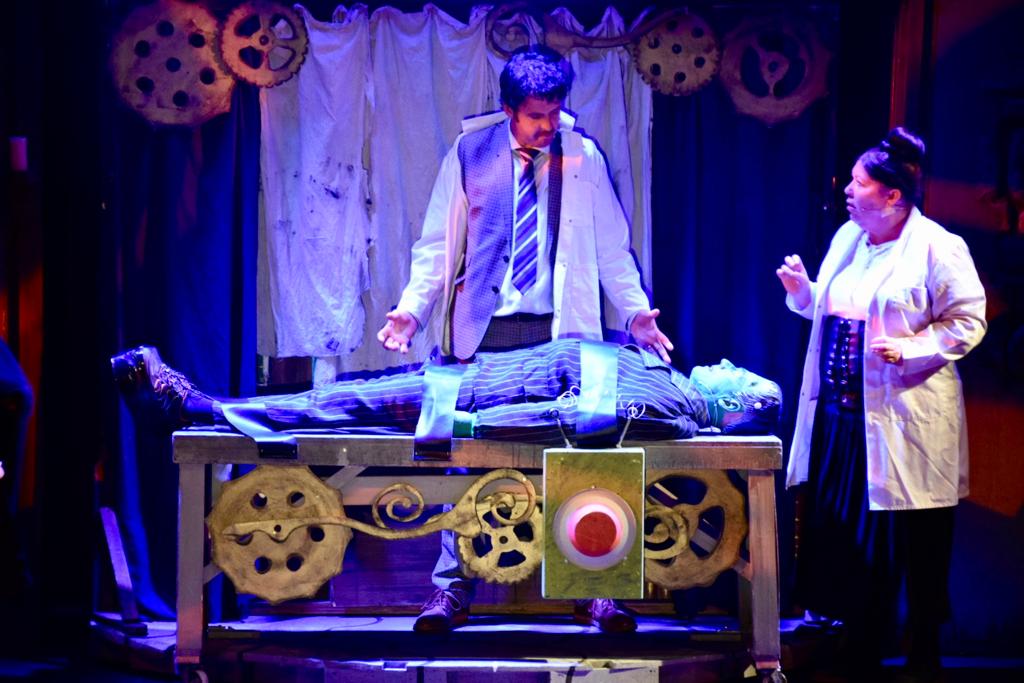
YOUNG FRANKENSTEIN – 2022 – The Devonport Playhouse
Directed by Amanda Paddison
Musical Direction by Kristy Marcer-Griffiths
Thank you for inviting me to your production and may I say, what an absolutely exceptional warm welcome my wife and I received upon entering the theatre by an ever so friendly front of house team. What an excellent job they do at creating a warm atmosphere to all members of the audience arriving. We made our way to our seats promptly and were met by a fabulously well designed set by Andy Martin Productions. Andy always makes excellent use of the unique stage at the Devonport playhouse and this was no exception. The rotating wall to the laboratory worked seamlessly well!
Young Frankenstein is a new(ish) musical comedy based on the 1974 film of the same name by Mel Brooks. Grandson of the infamous Victor Frankenstein, Frederick Frankenstein (pronounced “Fronk-en-steen”) inherits his family’s estate in Transylvania. With the help of a hunchbacked side-kick, Igor (pronounced “Eye-gore”), and a leggy lab assistant, Inga.
It is always nice to see a live band in the pit and this show was led by the fairly new Musical Director Kristy Marcer-Griffiths who did an excellent job at leading this ensemble and indeed preparing the cast for the performance. It may be noted however that, perhaps due to an extensive break over the COVID-19 period, that some members of the cast were extremely reliant on the MD for their cues which meant that occasionally their focus was entirely on the pit and not toward the auditorium. It would be nice to build their confidence to be able to hear the cues and therefore maintain that engagement with the audience throughout as did happen for most of production.
Frederick was a strong performer who had great characterisation for this role. He was able to draw the audience in. Occasionally during his songs, the diction did get a little lost when singing a particularly fast and wordy section but overall he was a good singer.
“Please don’t touch me” sung by Elizabeth was hilarious and she hit the mark every time with her comedy throughout this song. Being a musical comedy it is essential that the cast responsible for these comic moments are able to deliver their lines correctly in order for the comedy to shine through, and generally this was the case throughout. The audience were well and truly laughing away at so much of the naughty adult humour that is littered throughout this production.
Victor appeared in the portrait in the Frankenstein home and he was remarkably still throughout this scene before “coming alive” to sing “Join the family business”. You could be forgiven for believing for a moment that he was a real painting and not a person as he stood so still. Victor was a strong singer and this song was delivered very well. It was a shame that Victor didn’t return back to his position in the portrait or exit where he had come from. This would have just given an extra level of consistency to this scene.
Inga was another very strong performer with excellent vocals. Her character was incredibly funny and characterisation was convincing. Frau Blucher had me in hysterics with her solo of “He Vas My Boyfriend”. Dragging the chair in a tango-esque manner whilst walking with the finesse of an elephant had the audience in tears and was perhaps a show-stealing number.
The Monster was incredibly well done and the costume was outstanding. To deliver such comedy whilst not saying a single word for most of his time on stage is an absolute credit to his physical performance skills as an actor; And I really did laugh at lots of what The Monster did.
Igor had great characterisation and played this part excellently. I bet he had a bad back after walking with his hunched posture throughout show week!
The stage crew worked very effectively throughout and scene changes happened very slickly and allowed the pace of the show to keep pushing forward all the way to the end. Where suitable the director made excellent use of the cast to aid in these scene changes and again this helped to keep the performance moving.
Overall it was an evening filled with laughter and entertainment with the cast delivering all of the comedy throughout well with excellent set and costumes.
Congratulations on a great show.
Kind regards
Ryan Procter
District 3 Representative
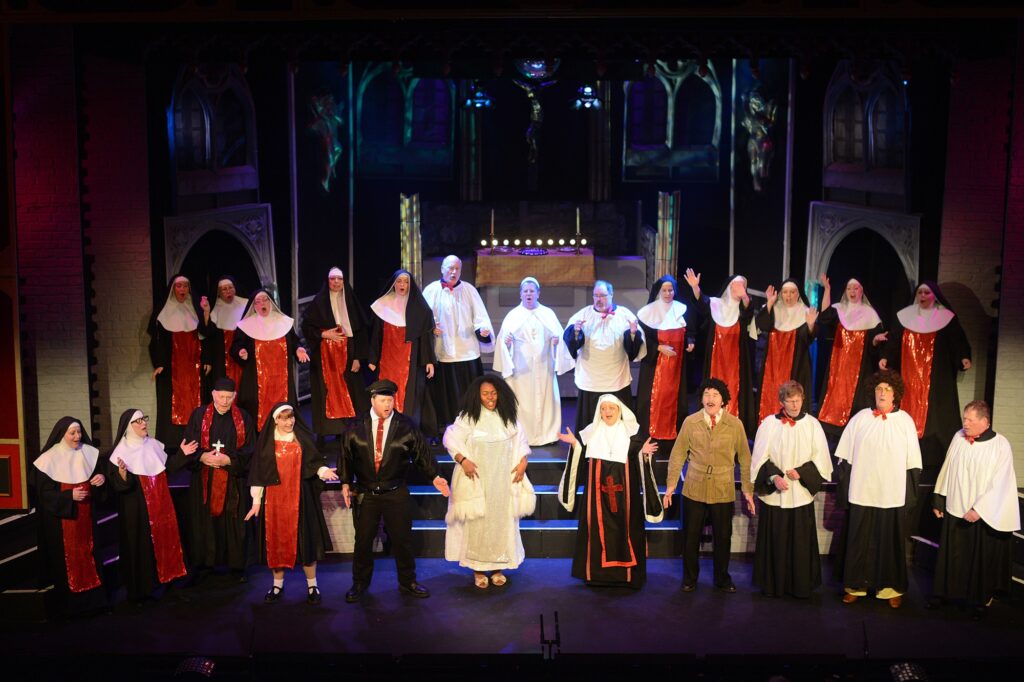
SISTER ACT – 2018
NODA AWARD RECIPIENT: Company Singing & Outstanding Achievement Award
I love this musical! ‘Sister Act’ is based on the 1992 Whoopi Goldberg film comedy of the same name. It tells the story of Deloris Van Cartier, an aspiring disco diva in the 1970s. After witnessing her gangster boyfriend, Curtis, commit a murder she is put into protective custody in a convent, which is facing closure. Finding this new ‘lifestyle’ difficult, she eventually joins the convent choir and finds friendships and sisterhood that she has never known before.
I remember first seeing ‘Sister Act’ (on a very wet summer’s afternoon) at the London Palladium when it opened with Sheila Hancock and Ian Lavender starring. First impressions of that production were that the opening sequence was slow and that was again apparent in this production. For me, this brilliant musical jumps into life when Delores joins the convent. Deloris is, of course, the lynchpin of the show, rarely off stage and was played very strongly by Cairo McFarlane. From her first appearance, she gave a first class performance. She was sexy and seductive in the opening scenes and coped beautifully with the complexities of the character. Both her singing and acting skills were superb and together with her excellent comic timing, this was a terrific portrayal.
I loved the interpretation of Mother Superior by Diane Hooper. She had just the right amount of idealistic authority but became completely exasperated by the situation and her singing of the beautiful ‘I haven’t got a prayer’ was delivered with sensitivity, a very classy performance. Joanne Studs was great as the somewhat surly Sister Mary Lazarus and her transformation into a ‘rapper’ was hilarious. Sheilagh Francis excelled as the excitable and over enthusiastic Sister Mary Patrick, while Jasmine Smith captured the innocence, curiosity, courage and sweetness of Sister Mary Robert to perfection. The nuns were brilliant throughout.
Leigh Jarman as Curtis was the villain of the piece, with his three sidekicks Barrie Lewis (TJ), Tom Harwood (Joey) and David Parish (Pablo) who were funny, especially in the song and dance routine, ‘Lady in the Long Black Dress’.
Stacey Goff sympathetically played Eddie, the police officer in love with Deloris, and his quick costume changes during ‘I Could be That Guy’ were splendidly achieved. Edward Gigg brought a rather mischievous touch to the role of Monsignor O’Hara – it was great to see Edward on stage again – and great support came from Jo Katz as Tina, Kate Stables as Michelle, Annie Worth as Sister Mary Martin-of-Tours and Denise Avent as Sister Mary Theresa. After the initial deliberately painful singing by the Nuns they definitely improved and were then in very fine voice throughout. The ensemble gave their all in the various roles they played.
This is a show with fourteen scenes in Act 1 and eleven in Act 2 which is an immense challenge when you have such a challenging stage but the extremely innovative and creative set designed, constructed and painted by Andy Martin coped with this admirably and was enhanced by excellent lighting and appropriate props.
Denise Avent and Nicky Staddon expertly managed the costumes by Triple C Costume Hire. Everyone embracing the 1970s fashion must have had lots of fun!
Musical direction by Marcus Alleyne was excellent throughout, conducting a brilliant band. This is a demanding show musically, for the singers and band, but this was a very strong musical performance in most aspects.
Direction by Amanda Paddison was generally fluid and the space was used with imagination. Sometimes I felt scene transitions could have been faster paced and too many songs were planted DSC for my liking. The finale felt a little awkwardly staged in places – chase and fight scenes are always tricky – but there were moments in the final sequence which needed reworking to sustain the believability of the piece.
This was a show full of fun, and played with such enthusiasm, vitality and exuberance, especially in the big numbers, which were well choreographed and executed. I enjoyed every minute and for much of the two hours I was ‘taken to Heaven’!
To everyone involved, well done and thank you. This was the best production I have seen from Sounds Musical Theatre Company in recent years.
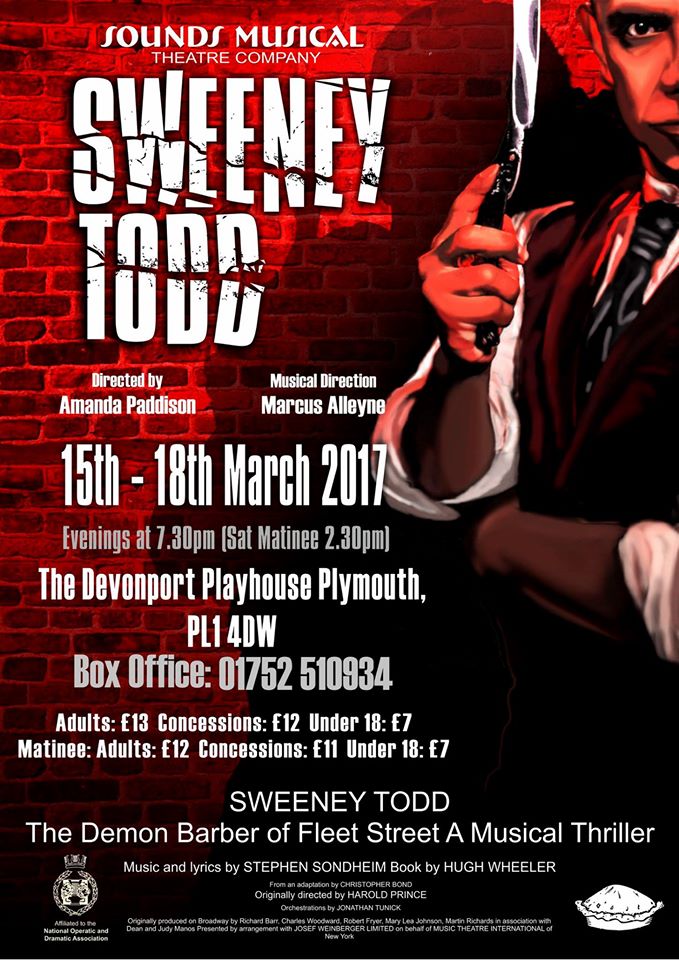
SWEENEY TODD – 2017
Playhouse stage has a raised upstage area which can present challenges to the Director and Set Designer, but it does lend itself nicely to the composite set necessary to keep this show moving at a good pace. The forestage extensions left and right were used for the asylum and Judge’s house respectively, with working doors. Each had a window from which Johanna could sing ‘Green Finch and Linnet Bird’ in Act 1, and to mirror this when she was at the asylum window, having exchanged one ‘prison’ for another.
Mrs Lovett’s bakery was placed downstage left with Sweeney’s Barber shop above it, connected by a short flight of stairs. This platform allowed the use of the ‘chute’ for the bodies to drop down after Sweeney had gone about his wicked business of murder. The chair itself looked very authentic and was operated well by Sweeney.
This production was greatly enhanced by some atmospheric lighting. The Barber shop was well isolated by light and I liked the spotlight on the chair at the end of the show. The red light as Mrs Lovett perished in the oven was very effective.
There had obviously been a lot of hard work by the actors, perfecting such difficult songs, and the musical accompaniment came from an excellent orchestra. The lack of amplification of the actors’ voices meant that often we were not able to fully appreciate the complex harmonies or the witty Sondheim lyrics, and therefore at times the story-telling was lost.
There were a few issues with pace at times in Act 1, but I think this was mostly due to the structure of the show. It can be difficult to push the pace when everything is sung, as the speed of delivery is governed by the songs themselves. Also Act 1 is a long act. Possibly this could have been helped by faster or more energetic entrances? The pace in Act 2 was excellent, as Sweeney’s world started to unravel before our eyes, and we were really swept along by the story.
There was some excellent ensemble work, in particular in the asylum scene which was very realistic and atmospheric. I liked the way the chorus were used to mask the bringing on of the ‘bodies’ of the Judge and the Beggar Woman. The Principals worked well as a team. There was a good contrast between Sweeney’s quiet brooding demeanour and Mrs Lovett’s more frantic, nervous energy which brought real interest to their scenes. Anthony was very sympathetically played, and it was easy to believe in the love affair between him and Johanna, despite the speed with which the script requires them to fall in love! The Judge was suitably sleazy and formed a good partnership with the Beadle.
I understand that there were some late cast changes in this show, but I have to say that I would not have known this if I had not been told, as it was a very accomplished and polished production. Congratulations on an excellent ensemble show.

CAROUSEL – 2015
With no front tabs, we were able to study the set before the start of the show. The flats consisted of simple wooden slats, and there were branches across the proscenium arch. The rest of the set was covered with dust sheets, and these were removed by cast members (Mrs Mullin and Billy) at the start of the overture. They revealed a beautiful carousel with hanging horses up left, with various fairground booths on the raised area of the stage, and two ‘distressed’ benches in the lower, downstage area. These benches remained on for many of the scenes.
The overture continued to build with the introduction of fairground customers and the many different fairground characters. Billy Bigelow mimed the part of the fairground barker with great energy, and the beautifully played Carousel waltz completed this impressive opening.
This company are fortunate to have some excellent singers and their chorus singing throughout was very impressive, with some lovely harmonies. The dance breaks featured some very accomplished dancing and some nice choreography, although no choreographer was credited in the programme. I would have liked to have seen the dancers more integrated into the chorus numbers, instead of entering just for the dance breaks. Equally, some more movement from the singers would have given the chorus numbers a more cohesive feel.
All the soloists were in possession of fine voices. However with the orchestra in front of the singers, and no radio mics used, there were times (particularly when there was underscoring) when it was difficult to hear or understand the dialogue and lyrics.
Costumes, hair and make up were all right for the period. Some of the clothes (the fishermen’s outfits, the women’s aprons) looked rather too clean and freshly laundered, considering the ‘rough and ready’ lifestyle of these people, but I know how difficult it can be to ‘dirty up’ hired costumes!
The sets were lovely, in particular the ‘heaven’ scene had a beautiful simplicity to it which was very effective. Scene changes were efficiently and quietly performed, and the dropping in of the half tab was well timed. The lighting enhanced the production.
The success of this show is very dependent on the quality of the leading man, and this Billy Bigelow gave a fine performance as the troubled hero with a quick temper. He and Julie Jordan created a believable relationship and their duets were well sung. Enoch and Carrie gave very mature performances, and there were solid performances from Mrs Mullin and Nettie Fowler, whose singing of ‘You’ll Never Walk Alone’ was a highlight.
This was a good choice of show which allowed this society to play to it’s strengths.